Wednesday, July 15, 2009

July blooms day. Doesn't feel like mid-summer

Flowers seem to be a week or two late this year. We've had very cool temperatures, and lots of rain. The past two nights have gone down to 6.5 degrees C (43F), and daytime temperatures are comfortable. Is this really July?

I'm liking this summer very much. Heat and humidity: who needs it? Apparently, the tomatoes do: they're not growing well at all, but I only have three plants.

Here's a selection of what's in bloom right now:

Echinacea pallida is among the first flowers to bloom in our meadow

Persicaria polymorpha has been in bloom for a month: what a plant!

My semi-circular border with Persicaria, blue oat grass, Stachys officinalis and a silly-looking puff-ball Allium christophii (self sown, front right)

Eryngium giganteum (Miss Willmott's ghost) and Knautia macedonica
in our Piet Oudolf-inspired border (now the wild garden)
Photo: David Rees

Border mainstay: Echinacea purpurea
Photo: David Rees

In the meadow, the more delicate E. pallida

Lots of daylilies coming on now

Clematis 'Duchess of Albany', lady's mantle and lavender
in the four-square garden

In containers, we have my husband's seed-grown Agapanthus

My favorite Whichford pot in the front courtyard with wave petunias,
million bells, sweet potato vine and burgundy Dracena


At the front steps, a Canadian made pot (Night & Day Studio) with wave petunias and verbena, Cerinthe major (not in flower yet), white and purple Nierembergia in neighboring pots

Featured comment: Greetings from Night and Day Studio in Mount Forest!
Thank you for the credit on a fine terracotta planter, but unfortunately it is not ours. I do believe it is also a Whichford planter (applied lattice work). Thanks anyway and happy gardening!

Paul Kaye- owner-Night and Day Studio
www.nightanddaystudio.com

For more contributions to Garden Bloggers Blooms Day, head on over to May Dreams.

© Yvonne Cunnington, Country Gardener

Tuesday, July 14, 2009

Over the hump - our garden tour went well

Getting ready for a group garden tour is bit a like preparing for the opening night of a play. You want everything to be perfect, or at least as close to perfect as possible - as neat and trimmed and weed-free as you can get. With a big garden that's always growing and changing week by week, that's a tall order. But the garden looked great, and I think our guests, the Royal Botanical Gardens Auxiliary members, enjoyed themselves.

We used to host a lot of tours - one busy summer we had seven bus tours, which added a good deal of stress - so when I decided to simplify things, I dropped two things: the vegetable garden and big group tours.

Now, as far as the garden is concerned, I think I can relax for the rest of the summer. Sure, there are projects to do, but the urgency of a due date is gone. So far the season has been cool and moist, and I haven't had to fret about watering. I love it!

That's me on the right, in the coral blouse and straw hat

David Rees, who's working for us this summer, and who did the lion's share of making the garden tour-ready, took these pictures yesterday. You can see more of his photography on Flickr.

When David interviewed for the job here, I knew I was going to hire him as soon as he told me he was into photography, because that's my hobby too. I know that taking pictures doesn't have much to do with gardening, but he has turned out to be simply excellent at landscape maintenance. I count myself lucky to have his help this summer.

© Yvonne Cunnington, Country Gardener

Thursday, July 09, 2009

Oh summer, will you make an appearance soon?


Since we moved here 11 years ago, our summers have been dominated by drought. Indeed, the worst drought in 50 years plagued gardeners and farmers throughout 2007. So it feels really odd to be experiencing the second wet summer in row - at least so far.

According to the local paper, we had 30 percent more rain than normal in June and temperatures have been an average 1.5 degrees cooler than normal. So far, we've had only one day that was hotter than 30 C (86 F), and no smog days.

All of this means that garden and crop plants are about two weeks behind when they would normally bloom or ripen. Our serviceberries are usually ripe on the shrubs in late June, but this year I was picking them in July. The cool weather and excess rain affected local strawberries, which weren't very sweet or plentiful. In our garden, the time I've been saving on watering is spent mowing because the grass never stops growing, and needs cutting every four or five days.

All in all, I'm happy to take this over a hot, humid, dry summer, but I wouldn't mind a bit of warmth. It was so cool the other day that I changed into my winter uniform: a black turtleneck sweater and jeans. But I'm not complaining, except about the strawberries.

(The link for Agriculture Canada precipitation map is here.)

© Yvonne Cunnington, Country Gardener

Wednesday, July 08, 2009

If you water me in summer I'll die: Lewisia redivia

Lewisia redivia in the wild - growing in dark basalt rock

When my husband John started rock gardening, one of the attractions was to grow little-known and unusual plants such as Lewisia. Native to western North America, these alpine perennials are named for explorer Meriweather Lewis. (Maybe you have dim memories of learning about Lewis and Clark in high school too?)

One lovely Lewisia in our rock garden is L. coteledon, above, which John grew from seed. It lives in the garden wall and has thrived there for a number of seasons. (Not all alpines make it through our eastern winters with their rainy January thaws and sometimes cold, snowless weeks in February.)

The strangest Lewisia that John grows is L. rediviva, commonly known as bitterroot. When he first started growing it, I couldn't figure out why anyone would bother with a plant that must stay completely dry in the summer. If it gets watered, L. rediviva dies, so it has to be grown in pots and kept away from those who carry around a garden hose.


Our Lewisia rediviva in bloom and dormant

This need for summer dryness is an adaptation to a very dry natural habitat, best described as cold desert. The plant grows in gritty, gravelly soils in places where most of the annual precipitation falls as snow and there is very little rainfall during the growing season. L. rediviva likes it cold in the winter and dry in the summer. The plants have big fleshy roots, which keep them alive through dormancy.

When this plant was discovered in the early 19th century and specimens were sent to collectors, it attracted a good deal of interest when a dried specimen returned to life and began to grow, but the first attempts to grow it in Britain failed. The plants all died in that moist summer environment.

John's plants live in clay pots. They bloom sweetly in June and when the flowers are finished, he lets them dry out. Already they have gone completely dormant sitting on the front porch where they won't get rained on. Later they will spend the rest of the summer unwatered in the basement and over-winter in our unheated hoophouse.

The things rock gardeners do to keep unusual specimens going!

Photo credit (top photo): Thanks to wanderflechten, Flickr

© Yvonne Cunnington, Country Gardener

Wednesday, July 01, 2009

Soggy Canada Day

We've had a lot of rain this week. More flooding down at the creek today, as we got our second inch in as many days, and the ground was already sodden with the 2.25 inches from last Thursday. And to think I was complaining about the lack of rain just before this wet week started.

Which would you rather have: too much rain or drought? I'll take this over the once in 50-year drought we endured in 2007.

© Yvonne Cunnington, Country Gardener

Thursday, June 25, 2009

Did we ever get rain today!

I had been hoping for rain to give us some relief from a dry couple of weeks, and our current heat wave. Well, it rained, and how!

Creek banks flooding onto our property

Our little bridge across the creek under water

This was the scene following two and a quarter inches of torrential rain (and a bit of hail) that came down during the lunch hour. As always, the creek flooded and the lowest part of our property near the road is under water. By evening, it should be cleared, unless we get another thunderstorm.

The storm brought so much rain in such a short time that a road near us washed out in an area where they had just added a culvert and some gravel, but hadn't yet replaced the black-top paving. No damage here, but the petunias in my containers have been flattened. A small price to pay for much-needed rain, and they will perk up again.

© Yvonne Cunnington, Country Gardener

Monday, June 15, 2009

June blooms: we're in fragrance heaven

The most colorful spot in June - John's rock garden

Mmmmm, it really smells sweet here right now, particularly in the evenings. At the side door, the last of Palibin lilacs waft their scent and from behind the house comes the lovely perfume of the black locust trees.

Dame's rocket growing under a stand of sumacs
naturalized area around our silo

Walk to my husband John's rock garden, and there's the spicy fragrance of dianthus, mingled with that of dame's rocket, which grows wild under the sumacs nearby. Then at my four-square garden, it's the peonies, just starting to bloom. I remember well when we first moved here - 11 years ago now - there was no garden, and very little scent - just the black locusts.

A June bouquet from the 4-square garden:
peonies, lady's mantle and Siberian iris

So what else is in bloom for this garden blogger's bloom day? Well, we have rock garden plants (that garden has never looked better) - too many to mention, even if I knew what they all were.

A closer view of a part of the rock garden
with pink creeping baby's breath, dianthus, alpine alyssum

In my flowerbeds, there's beautybush, giant white fleece flower (Persicaria polymorpha), false blue indigo (Baptisia australis), lady's mantle, Siberian iris and Allium christophii, Salvia offincialis, and catmint.

Persicaria polymorpha, beautybush and false blue indigo
in my semi-circular border

Except for the rock garden, June isn't as colorful in most of my garden as July is. That's because my orientation is the prairie style, based on lots of ornamental grasses and masses of mid- to late-season perennials. Still to bloom too is our prairie meadow, which comes into its own next month.

For lots more on June Garden Bloggers' Bloom Day, head on over to May Dreams Gardens.

© Yvonne Cunnington, Country Gardener

Wednesday, June 10, 2009

Meet the culprits...the bulb thieves


They look pretty cute, these chipmunks, but they are systematically clearing my garden of all of its crocus and tulip bulbs. I keep finding holes they've dug everywhere around the house.

Our house is on a hill, and our patio is terraced with large rocks. Unfortunately, it's perfect chipmunk habitat, and I guess the thing to do is plant more daffodils, which I'm told they don't touch.

© Yvonne Cunnington, Country Gardener

Sunday, May 31, 2009

The importance of just looking

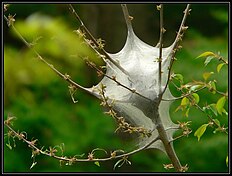
It's no wonder my garden helpers call me eagle eyes. Last week while looking out the kitchen window, I noticed something strange on a crab apple branch in the distance.

When I checked it out, I found a mass of eastern tent caterpillars that were quite big already. Fortunately, they were still inside the webbing that protects the egg mass, so I was able to grab the entire nest (wearing gloves, of course) and stomp on the critters with my garden boots, (which was satisfying).

So I had another look at all my crab apples trees, and sure enough, I found more caterpillars and was able to get rid of them just as easily. In the weeks before, I had already done the rounds of the trees, and removed at least a half dozen tent caterpillar egg masses.

It's a good thing I noticed the problem early - before the caterpillars were all over the tree branches eating up the leaves. By then it would have been too late to do anything about them. For example, Btk (a natural insecticide), is not effective once the caterpillars are longer than an inch. In fact, the caterpillars I found last week were already quite large and ready to leave their nest. Manual control was the quick and easy solution.

The moral of the story: Noticing things while it's still easy to fix them is the key. (When stuff gets out of hand, fixing it gets harder.) Same thing with weeds, there's nothing more depressing for than a weedy takeover of a flower bed. Maybe this is the reason I'm never relaxed in my own garden: I'm always noticing too many things.

Eastern tent caterpillar Photo by Greg Hume, at Wikipedia.

© Yvonne Cunnington, Country Gardener

Friday, May 22, 2009

Today's glorious spring moment

This is how one part of the garden looked this afternoon. We had three nights of serious frosts over the holiday weekend, and the Sugar Tyme crab apple tree above was hit, but thankfully the flowers appear to have weathered the cold better than it appeared at first.

The leaves of some hostas were also damaged, as were new leaves on oak and ash trees and the leaves and flowers of the French lilacs. My favorite Korean lilacs are fine because they were still in bud. What can you do? Mother Nature delivers good and bad.

I'm happy to report that my program of setting garden bootcamp days for early in the week and keeping Thursdays and Fridays for other things is going well so far.

© Yvonne Cunnington, Country Gardener