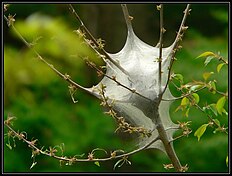
 It's no wonder my garden helpers call me eagle eyes. Last week while looking out the kitchen window, I noticed something strange on a crab apple branch in the distance.
When I checked it out, I found a mass of eastern tent caterpillars that were quite big already. Fortunately, they were still inside the webbing that protects the egg mass, so I was able to grab the entire nest (wearing gloves, of course) and stomp on the critters with my garden boots, (which was satisfying).
So I had another look at all my crab apples trees, and sure enough, I found more caterpillars and was able to get rid of them just as easily. In the weeks before, I had already done the rounds of the trees, and removed at least a half dozen tent caterpillar egg masses.
It's a good thing I noticed the problem early - before the caterpillars were all over the tree branches eating up the leaves. By then it would have been too late to do anything about them. For example, Btk (a natural insecticide), is not effective once the caterpillars are longer than an inch. In fact, the caterpillars I found last week were already quite large and ready to leave their nest. Manual control was the quick and easy solution.
The moral of the story: Noticing things while it's still easy to fix them is the key. (When stuff gets out of hand, fixing it gets harder.) Same thing with weeds, there's nothing more depressing for than a weedy takeover of a flower bed. Maybe this is the reason I'm never relaxed in my own garden: I'm always noticing too many things.
Eastern tent caterpillar Photo by Greg Hume, at Wikipedia.




 Posts
Posts


Good work Yvonne. I got to my new home too late this year to spot many problems. Being new to the south, I've got a lot to learn. There is at least one apple tree that has been eaten completely bare and is trying to grow leaves back. Every rose bush in the yard is just a stalk trying to put out roses that are pitiful looking. I want to reduce my stress by going with native plants here in the south that can withstand the bugs and heat. One thing I wish I was ready for is my guinea fowl again, they are known for their ability to have a really good eye for bugs too!
ReplyDelete"Just looking" is a great strategy for design, too. One of the best things I gleaned from reading Marjorie Harris was her concept of "creative staring."
ReplyDeleteCongratulations on your de-bugging. Anything that helps us avoid use of the big, chemical guns is a good thing.
Isn't there a garden quote: "The best fertilizer is the gardener's shadow (or footprint)?" If you're not out there, you won't see what's happening. And you have to really look. My Griffith Buck rose looked terrible last year, even before the Japanese beetles got to it. This year, I started looking on the undersides of the leaves. Found three different kinds of insects so far, all of them hungry!
ReplyDeleteYeah, they are creepy!
ReplyDeleteWe had just a couple of nests last in an ash tree and I was lucky to get them "under foot".