Tuesday, October 31, 2006

The best fall color shrub: Fothergilla gardenii


The leaves are now off most of the trees, but there are still a few spots of color, and good ones too.

My favorite shrub for fall color, though it turns later than many, is the dwarf Fothergilla (Fothergilla gardenii), which glows red, burgundy, yellow and orange all at once - and it's doing this right now.

Although native to the Southeast, ranging from the Carolinas to north Florida, and west toward the Mississippi River basin, Fothergillas are not a terribly well-known shrubs.

Dwarf Fothergilla only grows three feet or so tall, which makes it a very practical size for most gardens. In spring it has creamy white bottlebrush flowers that combine particularly well with 'Spring Green' tulips.

For more information on Fothergilla gardenii, and its taller relative, here's a good article from the Brooklyn Botanic Garden.

Thursday, October 26, 2006

Wet fall means fleeting color


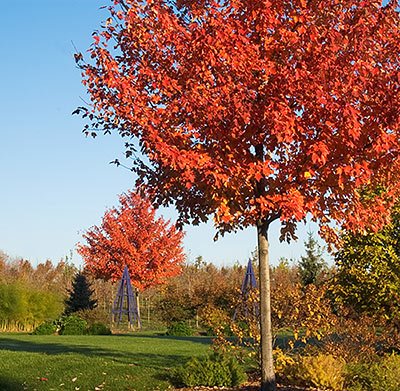
It's been a lovely year for producing fall color, but not so great for keeping it long. The trees pictured above, Red Sunset maples, now have only about a third of their leaves left.

I can't remember a wetter, colder, more blowy October. In the eight seasons since we started our garden here, fall weather has usually been warm and too dry.

Not this year. We've had weeks of rain. Just last week (on my birthday, as it happened) three inches of rain fell in one day, when the ground was already saturated. Some present! May and June's weeks of drought are now a distant memory.

Monday, October 16, 2006

Frosty morning pictures

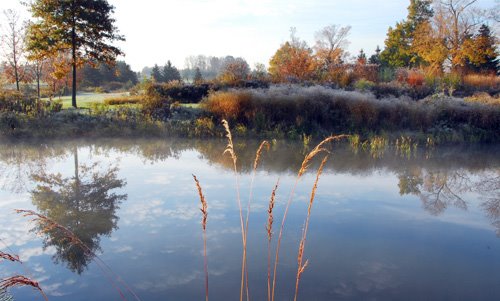
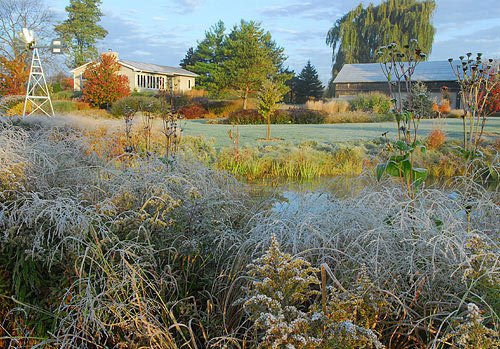
No time for words this morning, so pictures will do. It was one of those frosty mornings when getting out the camera is mandatory, no matter what else has to be done. Despite bad weather last week, the fall garden colors are still pretty splendid. I had my Nikon set on "Vivid" today as an experiment, kinda like the old Fuji Velvia 50 film I used to love.

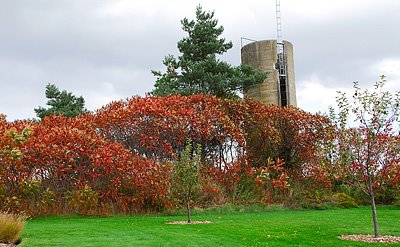
Getting another shot of the sumac at the silo from the farm pond side:


Shooting from the silo side of the pond, showing the plantings beyond the pond:


This is shooting towards the house and barn over the farm pond:

Friday, October 13, 2006

Staghorn sumac in the country garden

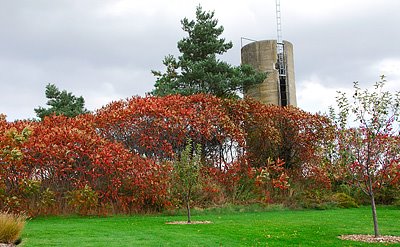
We have plain old staghorn sumac growing around our old silo – all that's left of the old barn site – and it's the perfect landscaping for that spot, courtesy of Mother Nature. Before we came, a previous owner had also planted a few Scotch pines around the silo, and the pine/sumac combination looks wonderful. We keep the sumac in bounds by mowing around the silo.

Staghorn sumac (Rhus typhina) isn't often planted as a garden shrub because it is one of those great spreading shrubs, suckering from the roots to form a large colony. Maybe the other reason sumac is not much appreciated is that it grows wild all around us.

Woody plant expert Michael Dirr warns that it has to be sited carefully, and that it needs maintenance to keep it in bounds, but he adds: "Europeans have long appreciated R. glabra [smooth sumac] and R. typhina. Perhaps some day Americans will become more introspective and appreciative of our rich woody plant heritage."

That aside, staghorn sumac is a great plant for acreages, where its wandering ways can be appreciated. The cutleaf cultivars are very graceful and have the best orange-red fall color.
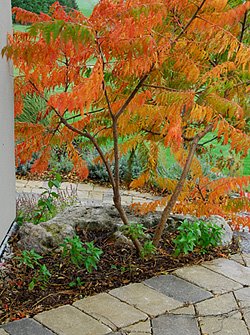
Perhaps foolishly*, I've planted the cutleaf sumac 'Laciniata' in a small bed at the corner of the house (shown here). The area is surrounded by an upper and lower patio, which theoretically should keep the plant contained. I just hope it won't damage the house foundation. (Dirr says not to use it as a foundation plant!)

I guess we can always tear it out if it gets to be a problem. For now, I just enjoy the great fall color, and I take heart from the advice about using this plant from the Brooklyn Botanic Garden:

Cutleaf staghorn sumac has ornamental possibilities that go beyond heavy-duty applications like highway landscaping. For large suburban properties it makes a good buffer plant for peripheral areas, where it provides not only summer privacy but food and habitat for animals as well; it makes an excellent "transitional plant" between tamed and wild areas.

With its size controlled by pruning and/or root confinement, cutleaf staghorn sumac can be used in manicured gardens. It can serve as a bolder, textured alternative to the ubiquitous dogwood and Japanese maple when planted off the corner of a structure to anchor a foundation planting. For hot outdoor plazas, it is a rugged survivor and makes a strong "statement."

For a mixed perennial border with a bold texture, try it as a specimen shrub to be cut back to the ground annually. Its wild appearance mixes especially well with grasses, and its spectacular fall color adds beautifully to any display of asters, chrysanthemums or goldenrod.
You can read the full article here.

(By the way, if you're wondering about the metal tower on the silo in the picture at the top, it's for our high-speed internet receiver. High-speed internet, can't live without it, right?)

*Three years on, spring 2009: We pulled that cutleaf sumac by the house out because it was taking over. The main plant was reaching everywhere and going under the patio with its amazing spreading root system. We've had to be vigilant to dig out all the bits all season long to keep at the ones we missed the first time. Lesson learned: this is a plant for the back 40!

Thursday, October 12, 2006

Fleeting fall color


I love this time of year. I don't think my garden is ever more beautiful than in October. And the same goes for all of nature up here in Ontario.

I took the above picture two days ago, but now the leaves on the 'Autumn Purple' ashes in the background have already been blown off. I've learned the hard way (many times!) that if you don't get out there with your camera the moment you see those "oh, my God shots", they're gone.

The weather is turning fast. After an achingly beautiful and very warm Canadian Thanksgiving weekend (Oct. 9th this year), we had pelleting rains all day yesterday, and there's frost and even a few flurries in the forecast for tonight, with tomorrow's daytime temperature in the single digits, around 8C! (That's 46F.)

Nyssa sylvatica - amazing fall color


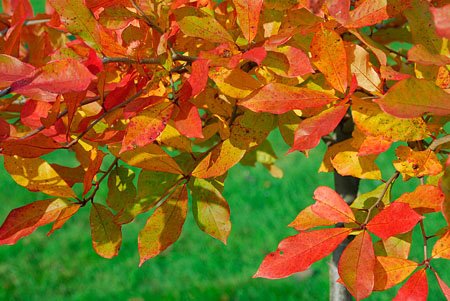
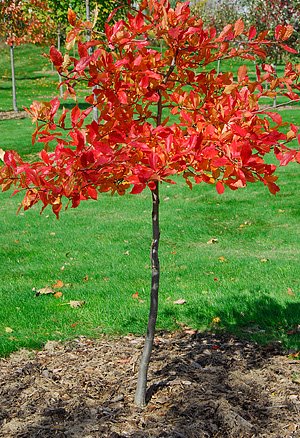
We've planted a lot of trees on our 10-acre property, but the most impressive one for fall color is Nyssa sylvatica, also known as sour gum, black tupelo or black gum.

Our tree (shown above and below) is still quite small, less that five feet tall, but certainly nicely established after planting two or three years ago.

Although Nyssa sylvatica is a North American native - it grows in Maine, Ontario, Michigan and ranges south to Florida and Texas - it is not easy to find at garden centers. This is mostly because the tree is hard to propagate from cuttings and has a tap root that makes transplanting larger specimens difficult.


The best way to get it established is to buy a container-grown plant in a small size and site it in a moist area. But you do have to hunt around: I managed to get one at the University of Guelph Arboretum plant sale.

Nyssa sylvatica will reach 30 to 50 feet in height, and grows 12 to 15 feet over about 10 to 15 years, so one needs a little patience, but its glossy leaves and outstanding fall color make it worth growing.

Here's a link to a good article about Nyssa sylvatica with lots more growing information.

Thursday, September 28, 2006

Gold Medal Plant: Tiger Eyes Sumac

I notice that Tiger Eyes sumac, officially Rhus typhina 'Bailtiger' Tiger Eyes®, has been given a Gold Medal Plant Award for 2007 by the Pennsylvania Horticultural Society.

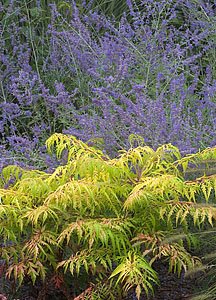
I planted Tiger Eyes a couple of years ago in my front garden, amid ornamental grasses and Russian sage. It was an impulse buy at the nursery, one of those plants with such gorgeously colored leaves that it was simply irresistible.

My picture shows it in August when our Russian sage was in full bloom.

This sumac is supposed to stay relatively compact, growing about 6 feet tall and unlike other sumacs, it's said not to be invasive.

So far, that's true here in my Zone 5 garden. If my plant is anything to go by, it's a slow grower. Mind you, I planted it on a hill in full sun in one of the few sandy soil spots on our property – which is mostly clay – during a dry summer. It was all I could do to water it enough to keep it alive.

The shrub is still compact - just about 3 feet tall - after its second season, but I suspect that it might just take off and put on some height next year.

Here's the description of Tiger Eyes sumac from the PHS site:

"This unusual Sumac has purplish-pink stems displaying exotic cut-leaf foliage. Changing with each season, Tiger Eyes® starts out chartreuse in spring, turns bright yellow in summer, and blazes scarlet-orange in the fall. Tiger Eyes® is more compact than the species and is not considered invasive. It prefers well-drained soil but adapts well to poor soils and urban situations, exhibiting good pollution tolerance. Great for the foundation, as a specimen, in mass, or in containers, it grows about 6 feet high and wide in full or part-sun. Hardy in Zones 4 to 8."

For more information on the other PHS Gold Metal plants, click here.

Note: As this post is almost 4 years old, I will not publish any more comments or questions regarding about this topic here. If you have a question or comment, please use the contact form at my new blog.

Wednesday, September 27, 2006

Still in bloom: Sonata Cosmos


I don't grow a lot of annuals, but I do have a few long-blooming favorites that I think are perfect country garden flowers, among them 'Sonata' cosmos.

Mine have been blooming since June, and even though we've had a couple of light frosts they haven't been hit yet. I just love going out every morning to be greeted by their cheerful faces.

You can simply direct-seed them, but I like to start them in containers and plant them as seedlings in any bare spot in my beds. I do hope they self-seed next year, as they used to do in my city garden.

I generally buy the mixed seed packet because I love all the colors they come in, from light pink and white to the darker pink shown here.

For more on easy self-seeding annuals and how to direct seed them, click here.

Monday, September 18, 2006

Hydrangeas in the fall


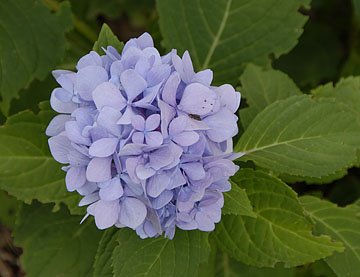
The best thing about hydrangeas in the fall is their long-blooming flowers. I have several Pee Gee hydrangeas in bloom right now, and the cultivar that looks most impressive is 'Limelight', shown here.

I remember not liking this plant much when I planted a pair of them a couple of years ago. At the time I found the flowers too big and heavy for the size of the shrub. But as the plants have grown – they're now about five feet tall (and they got there very quickly) – their flowers look just right and in scale with the size of the plant.

When ‘Limelight’ comes out, the flower heads are lime-green, but they gradually fade to a pinkish and then tan hues, like most hydrangeas.

My ‘Endless Summer’ hydrangea, planted a couple of years ago, is still a tiny thing. First, it suffered in a spot that was too sunny and dry. Then my garden helper pulled it out by mistake and threw it into the compost pile.


I rescued it later that day and kept it very moist in a pot until it recovered. Then we planted it in a shadier spot and it's alive, although still very small, but flowering nicely, (shown here). Will it thrive? The jury is still out on that one.

Anyway, moral of the story: don't be too quick to judge a cultivar. It often takes a couple of seasons for plants to come into their own.

I have more information about hydrangeas here on my website.

Thursday, September 14, 2006

Fall in the country garden


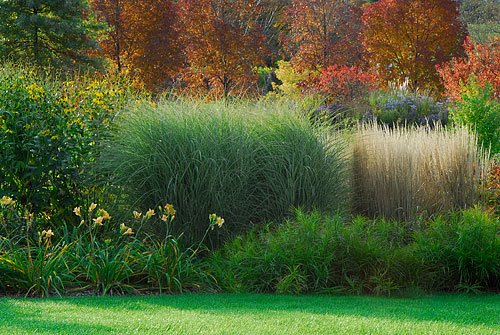
I've long been enchanted with the autumnal country garden look pioneered by garden designers Wolfgang Oehme and James van Sweden in the United States, and Piet Oudolf, in Holland.

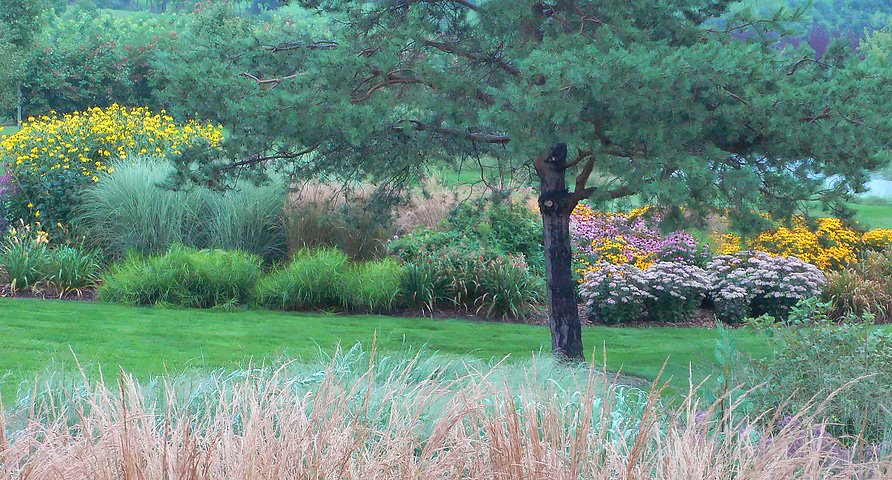
One of the reasons we moved to the country was to have the space to grow many late-season perennials and the big swathes of ornamental grasses that look so good with them. I took the picture above one morning early this month looking down at the garden from my front door.

I notice that a lot of gardeners seem to miss out on fall. By late summer, they're ready to throw in the towel. I understand being tired of gardening by August (I know I am!), but it's still a shame to miss out on the beauty of fall.

For the most part, plants that bloom in late summer and fall are tough, drought tolerant and many of them grow tall and dramatic. Another interesting fact is that many of them are North American natives, which accounts for their toughness: they shrug off the drought, heat and humidity of our summers because that's the very climate that shaped their evolution.

For us northern gardeners the growing season is short enough so if you have the space, why not extend the flower show well into fall with some lovely late-bloomers and ornamental grasses? (I have lots of information about fall perennials and ornamental grasses on my web site here and here.)